Outside-in analysis / September 2026, updated October 2026
When one supermarket chain buys another, how do its warehouse footprint and store deliveries change?
A step-by-step comparison in SCMotif, using the example of Edeka’s takeover of Tegut
00 / The context
The Tegut takeover
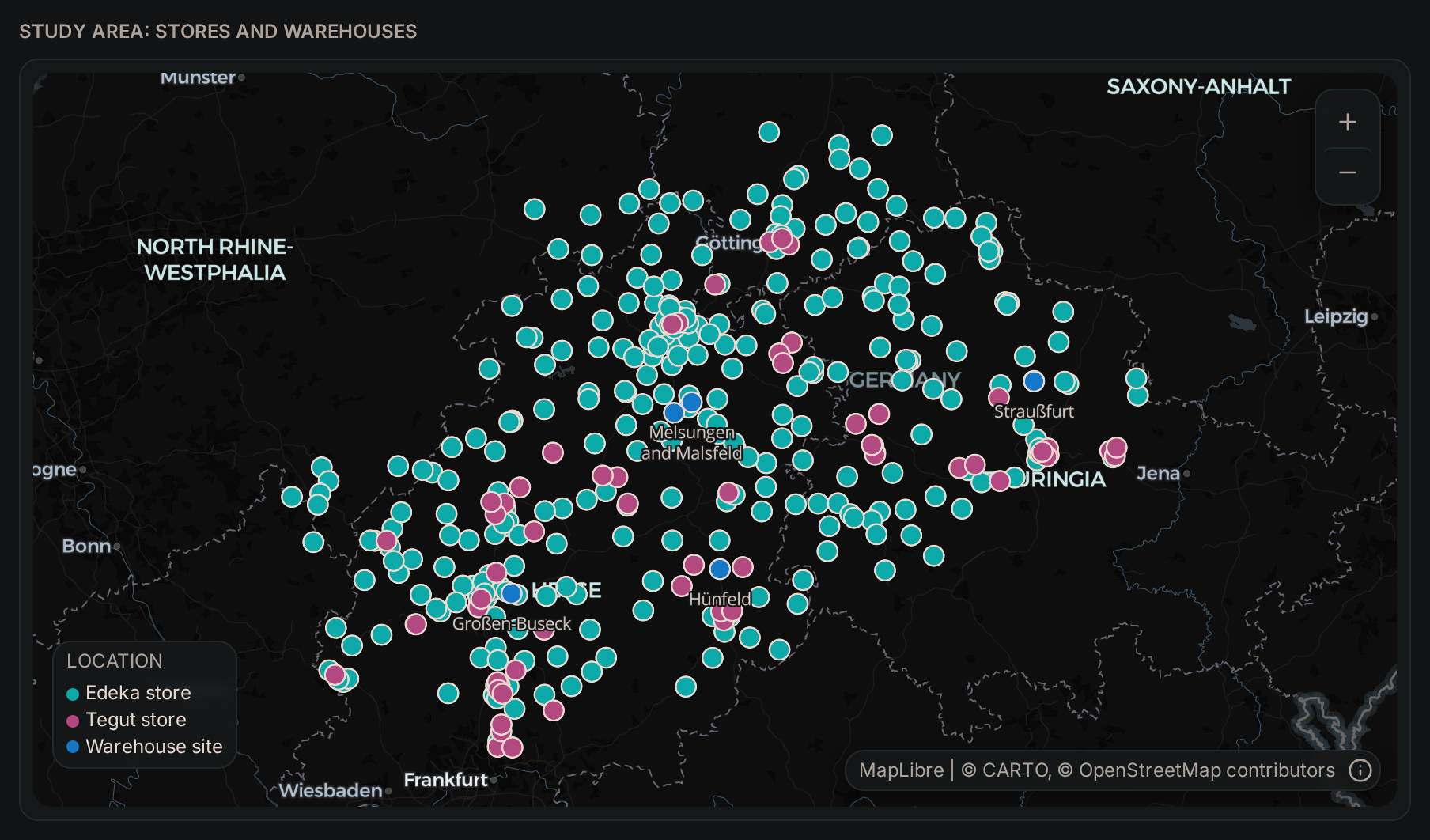
When a retailer buys another chain, it takes on new stores that need supplying. If the deal includes a logistics centre (warehouse), the buyer also gains a new way to supply them, and possibly its existing stores as well. Two questions follow: which warehouse should supply which store, and which warehouses does the network still need?
The food retail chain Tegut runs about 300 supermarkets in six German states. In March 2026, its owner, Migros Zürich, announced its withdrawal from Germany and an agreement to sell a large part of the business to Edeka, Germany’s largest food retailer. The package includes stores and Tegut’s only central warehouse, in Hünfeld near Fulda, which supplies all of its stores with dry and fresh goods (Migros announcement ↗). Regional press reports that the site’s future next to Edeka’s own warehouses is open (Osthessen News ↗).
Edeka is organised as seven regional wholesale companies, each with its own warehouses. The Tegut stores around Hünfeld lie in the area of Edeka Hessenring, which supplies its stores from warehouses in Melsungen, Großen-Buseck and Straußfurt. Hessenring is also building a new warehouse in Malsfeld. The intralogistics company WITRON is equipping it for automated dry-goods picking, with operations planned for mid-2029 (WITRON announcement ↗).
Edeka applied to take over 202 supermarkets and 41 teo micro-stores. On 28 September 2026, Germany’s competition authority cleared 178 of the supermarkets, the teo locations, the Herzberger bakery and the Hünfeld warehouse; Edeka gives up the other 24 locations for four years. The authority published the list of cleared stores (Bundeskartellamt ↗). Rewe is buying up to 40 of the other Tegut stores and Tante Enso 36 (Other buyers ↗).
We look at the case from Edeka Hessenring’s side. Which of the new stores should which warehouse supply, and what does that mean for the warehouse footprint? We answer in three steps: first by distance alone, then with the cost advantage of Hünfeld’s automation, and finally with Malsfeld in the network. We compare these options in SCMotif, using public information and documented estimates.
01 / The model
Edeka Hessenring’s stores, including Tegut
Edeka Hessenring publishes a map of the area it supplies, and Edeka’s store finder lists each store’s regional company. We take the 310 Hessenring stores inside that area and the 59 Tegut stores in it that the competition authority cleared for Edeka, 369 in total. Hessenring reports supplying more than 500 stores; the store finder does not show the difference (Edeka Hessenring ↗).
The other 119 of the 178 cleared stores lie outside Hessenring’s area, most of them around Frankfurt and Munich, where other Edeka regional companies supply the stores. Hessenring’s area holds 114 Tegut stores in all. Of the 55 that are not on the list, some are among the 24 locations Edeka gives up and the rest were not part of Edeka’s application.
Every scenario serves the same stores with the same demand. Today, three Hessenring warehouses can supply them: Melsungen, Großen-Buseck and Straußfurt. Hünfeld joins after the takeover, and Malsfeld from 2029.
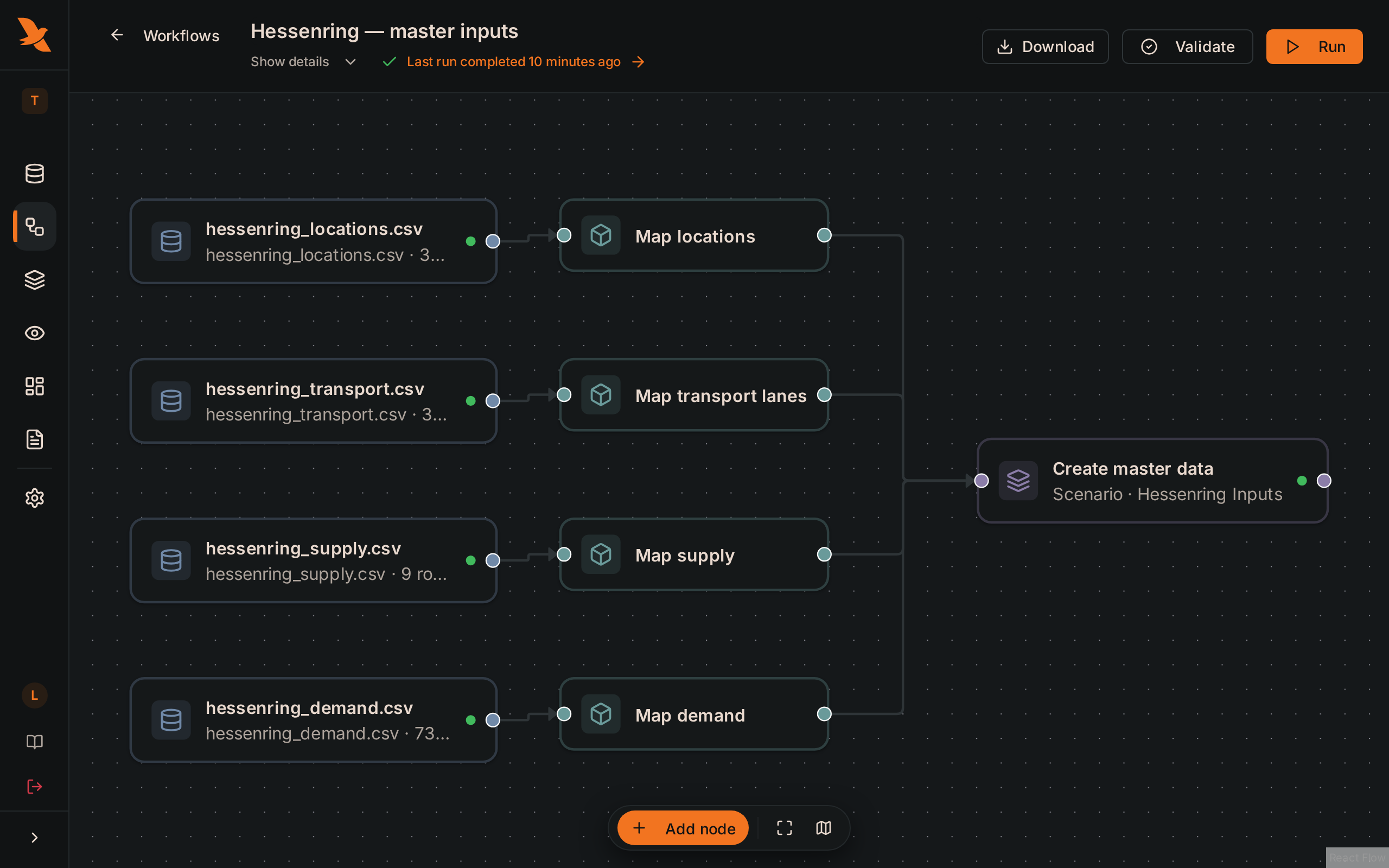
In SCMotif, one master-data workflow combines the locations, demand and transport costs for these stores and saves them as the scenario Hessenring Inputs. Every step loads that same starting point.
The common basis
What each comparison holds constant
Demand per store
We have no sales or shipment data per store, so every store gets the same demand: 5,500 roll containers (RC) a year, 60% dry goods and 40% fresh.
Volume assumptionsTransport costs per roll container
We calculate transport from the road distance between each warehouse and store, with one formula per product for every warehouse. A 100 km journey costs about €7.60 per roll container for dry goods and €12 for fresh goods, which travel in refrigerated trucks with smaller loads.
Rate and worked exampleHandling costs per roll container
Handling depends on automation and product. Fresh goods are picked by hand at every site, at €14.50 per roll container. For dry goods we estimate €13.50 at the manual sites, €12 at Hünfeld, whose automation covers storage and part of the picking, and €9 at Malsfeld, which picks dry goods fully automatically. The distance-only comparison sets the same rates at every warehouse, so only transport decides.
Site handling ratesVolume assumptions
Tegut’s revenue of about €1.3bn across roughly 300 stores gives about €4.3m in sales per store. About a fifth of a supermarket’s sales usually bypass the warehouse: beverages, bread and regional suppliers deliver directly. At about €650 of goods per roll container, the rest is about 5,300 RC a year, which we round to 5,500, or around 18 per delivery day. The 369 stores in our area need 2.0 million RC a year. As a check, Tegut’s roughly 300 stores would need about 1.65 million RC a year from Hünfeld, around 150 truckloads per working day. Frozen goods usually run through separate warehouses and are left out.
Tegut’s teo micro-stores, small automated shops without staff, are cleared too, but the published list does not locate them, so they are left out. Because every store has the same demand, a different volume changes every cost figure in proportion and leaves the assignments unchanged. Section 05 shows the results at 7,500 RC per store.
Rate assumptions and worked example
Road distances between each warehouse and store come from OpenStreetMap routing. The cost of a truck journey starts with a rate per truck-kilometre, excluding tolls: €1.50 for an ambient truck and €1.70 for a refrigerated one. Allowances for return driving, tolls and delivery routing follow.
Two allowances account for driving beyond the direct warehouse-to-store journey:
- Return driving: add 55% for dry goods and 70% for fresh goods. It allocates part of the return-driving cost to the delivery, and tolls follow the same share. Refrigerated trucks carry fewer goods back on the return leg. It does not mean that the model calculates a return route.
- Delivery routing: add 15% for dry goods and 20% for fresh goods. This is a cost allowance for a delivery tour being longer or more involved than a direct connection; fresh goods go to stores more often, in smaller drops. The model does not calculate the sequence of stops.
| Step | Dry goods | Fresh goods |
|---|---|---|
| Base driving | 100 km × €1.50 = €150.00 | 100 km × €1.70 = €170.00 |
| Return-driving allowance | 55%: +€82.50 | 70%: +€119.00 |
| Tolls, 70% of the route at €0.348/km | outward + 55%: +€37.76 | outward + 70%: +€41.41 |
| Subtotal | €270.26 | €330.41 |
| Delivery-routing allowance | 15%: +€40.54 | 20%: +€66.08 |
| Estimated transport cost | €310.80 | €396.49 |
Both allowances are estimates. Return driving and delivery routing can overlap in practice, so their combined effect needs checking against actual tour costs. They do not replace a vehicle-routing calculation.
estimated transport cost ÷ effective roll-container load
The effective load is the truck’s roll-container capacity multiplied by its assumed utilisation: 48 RC at 85%, or 40.8 RC, for dry goods, and 44 RC at 75%, or 33 RC, for fresh goods, which leave the warehouse daily in smaller loads. For the 100 km example, that gives €7.62 per RC for dry goods and €12.01 for fresh goods. The model applies the same formulas to every warehouse–store pair.
Site rates and sensitivity assumptions
| Warehouse class | Sites | Dry / RC | Fresh / RC |
|---|---|---|---|
| Manual | Melsungen, Großen-Buseck, Straußfurt | €13.50 | €14.50 |
| Automated storage, part of the picking automated | Hünfeld | €12.00 | €14.50 |
| Fully automated case picking | Malsfeld (from 2029, dry goods only) | €9.00 | – |
These are model assumptions, not disclosed site costs. Fresh goods cost more to handle because of chilled storage and cold-zone work, and they are picked by hand everywhere. Section 05 tests a smaller and a larger automation advantage.
Why different rates? The intralogistics supplier SSI Schäfer’s Hünfeld project announcement describes automated pallet and shuttle storage feeding seven picking workstations. Seven workstations cannot pick a whole network’s volume, so fast-moving goods are still picked by hand, and the saving lies mainly in storage and replenishment. WITRON’s 2029 project announcement describes 18 machines that stack cases onto roll containers automatically, which replaces most of the picking work. Neither source gives handling costs per RC.
Automation can reduce picking effort without reducing every warehouse cost by the same percentage. De Koster, Le-Duc and Roodbergen’s literature review reports that picking can account for up to 55% of warehouse operating expense. That supports a cautious distinction between picking productivity and total handling cost; it does not establish a tariff for these sites.
The rates are our modelling choice. A site-specific estimate would need receiving, replenishment, picking, staging and loading, maintenance and energy on a consistent basis, with capital and fixed costs accounted for separately.
We choose which warehouses are available, and SCMotif’s Network Optimization node chooses the flows. For each store and product, it minimises volume × (transport + handling per RC).
Warehouse capacity is not limited and site fixed costs are excluded, so each result shows a change in transport and handling cost. Whether a configuration pays off also depends on what it costs to run each site, which we do not know.
02 / Distance
Which warehouse is closest to each store?
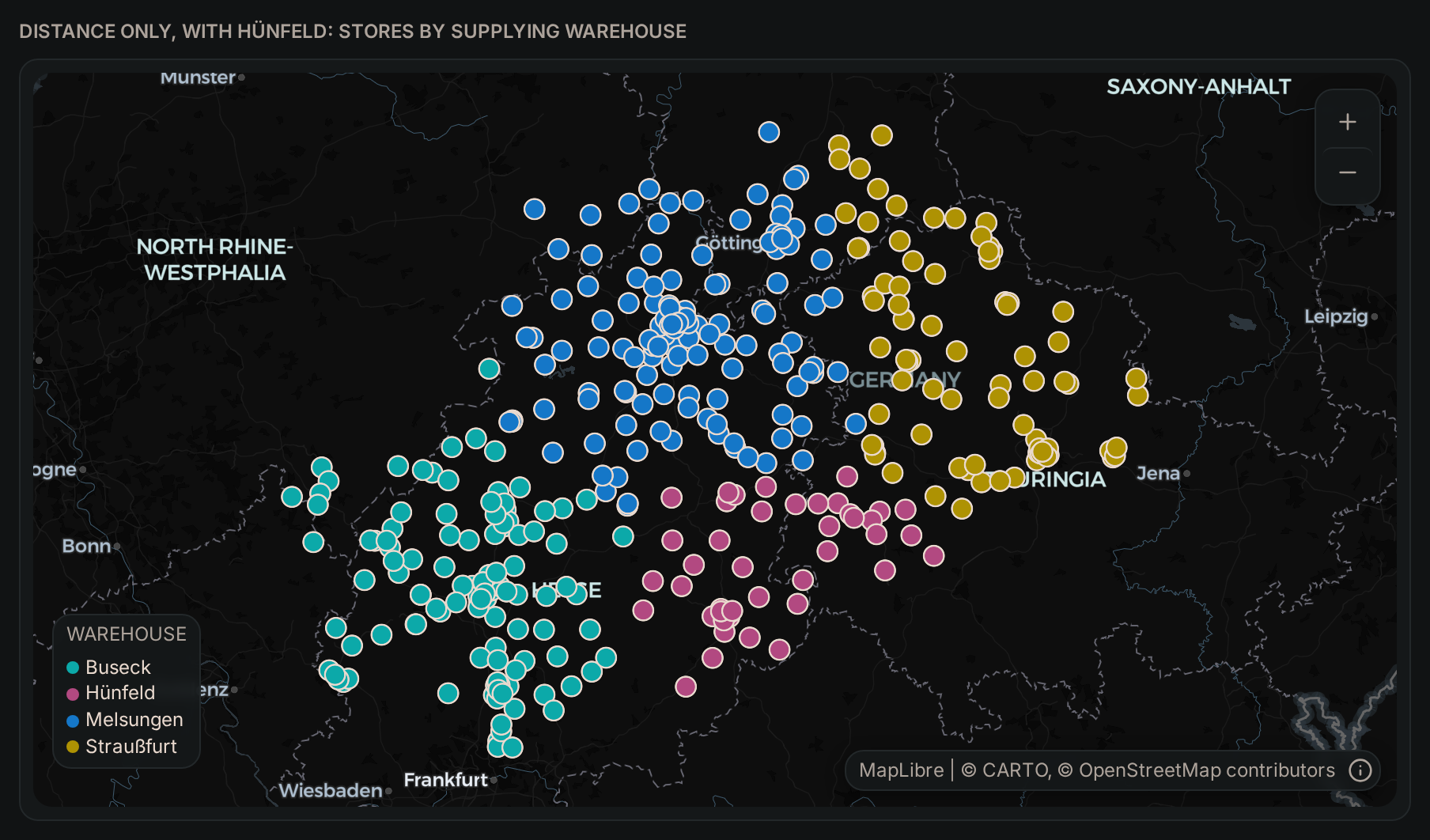
In the first step, every warehouse handles goods at the same cost: €13.50 per roll container for dry goods and €14.50 for fresh. Only transport decides, so each store goes to the warehouse it can reach most cheaply. We solve the network once without Hünfeld and once with it.
Without Hünfeld, Melsungen would supply 21 of the 59 Tegut stores, Buseck 23 and Straußfurt 15. With Hünfeld available, it takes over 44 stores: 8 from Tegut and 36 existing Edeka stores. They lie close to Hünfeld, in the district of Fulda, around Bad Hersfeld and in the Vogelsberg. The Tegut stores further north, around Kassel and Göttingen, stay with Melsungen.
Annual saving from Hünfeld’s location
€0.91m
Totals are transport plus handling. Handling costs the same at every site in this step, so the whole saving comes from shorter journeys.
| Warehouse | Without Hünfeld | With Hünfeld |
|---|---|---|
| Melsungen | 168 (21) | 132 (14) |
| Großen-Buseck | 115 (23) | 110 (22) |
| Straußfurt | 86 (15) | 83 (15) |
| Hünfeld | Unavailable | 44 (8) |
Follow one store: Tegut Schrecksbach
Melsungen is 46 km away by road, Hünfeld 54 km. Transport costs €3.53 per roll container of dry goods from Melsungen and €4.08 from Hünfeld; fresh goods cost €5.58 and €6.44. With the same handling rates everywhere, Melsungen supplies both.
| Warehouse | Road km | Dry goods | Fresh goods |
|---|---|---|---|
| Melsungen | 46 | €3.53 + €13.50 = €17.03 | €5.58 + €14.50 = €20.08 |
| Hünfeld | 54 | €4.08 + €13.50 = €17.58 | €6.44 + €14.50 = €20.94 |
| Großen-Buseck | 56 | €4.28 + €13.50 = €17.78 | €6.75 + €14.50 = €21.25 |
| Straußfurt | 160 | €12.16 + €13.50 = €25.66 | €19.18 + €14.50 = €33.68 |
In this step, Hünfeld’s advantage comes only from its location. Next, we add the cost difference between automated and manual warehouses.
03 / Automation
What changes when automated handling costs less?
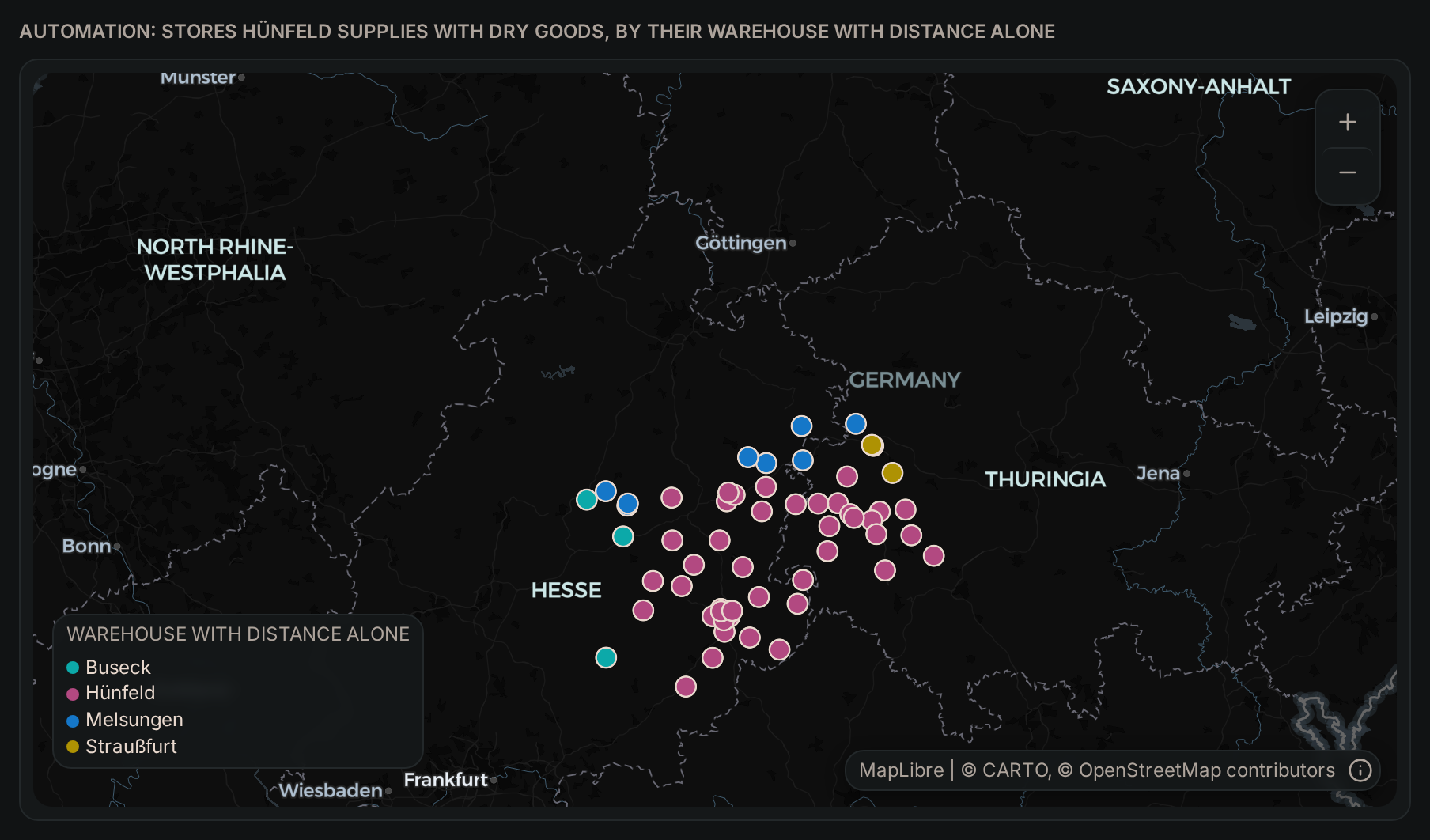
Hünfeld stores goods automatically and picks part of its range at automated workstations, while Melsungen, Buseck and Straußfurt are manual warehouses. We set dry-goods handling to €12 per roll container at Hünfeld and keep €13.50 at the other sites; fresh goods are picked by hand everywhere. A longer journey to Hünfeld pays off when the handling saving outweighs the extra transport: for dry goods, up to about 20 km of extra road distance.
Hünfeld now supplies dry goods to 58 stores, 11 of them from Tegut, and handles 14% of the volume. Compared with distance alone, it gains the dry goods of 14 stores: 8 from Melsungen, 3 from Straußfurt and 3 from Buseck. Their fresh goods stay where they were, because fresh handling costs the same everywhere.
Additional annual saving from automation
+€0.24m
Of the €1.15m, about €0.86m comes from shorter journeys and €0.29m from lower handling costs. Network cost falls from €38.14m to €36.99m.
Follow one store: Tegut Schrecksbach
Dry goods for Schrecksbach now cost €16.08 per roll container from Hünfeld (€4.08 + €12.00) against €17.03 from Melsungen, so they switch to Hünfeld. Fresh goods stay with Melsungen at €20.08 against €20.94.
Which warehouses does the network need?
We now remove sites and let SCMotif reassign the stores. The table compares each configuration with today’s network without Hünfeld.
| Available warehouses | Change |
|---|---|
| Existing sites + Hünfeld | −€1.15m |
| Hünfeld replaces Melsungen | +€1.37m |
| Hünfeld replaces Melsungen and Buseck | +€4.94m |
| Hünfeld only | +€8.89m |
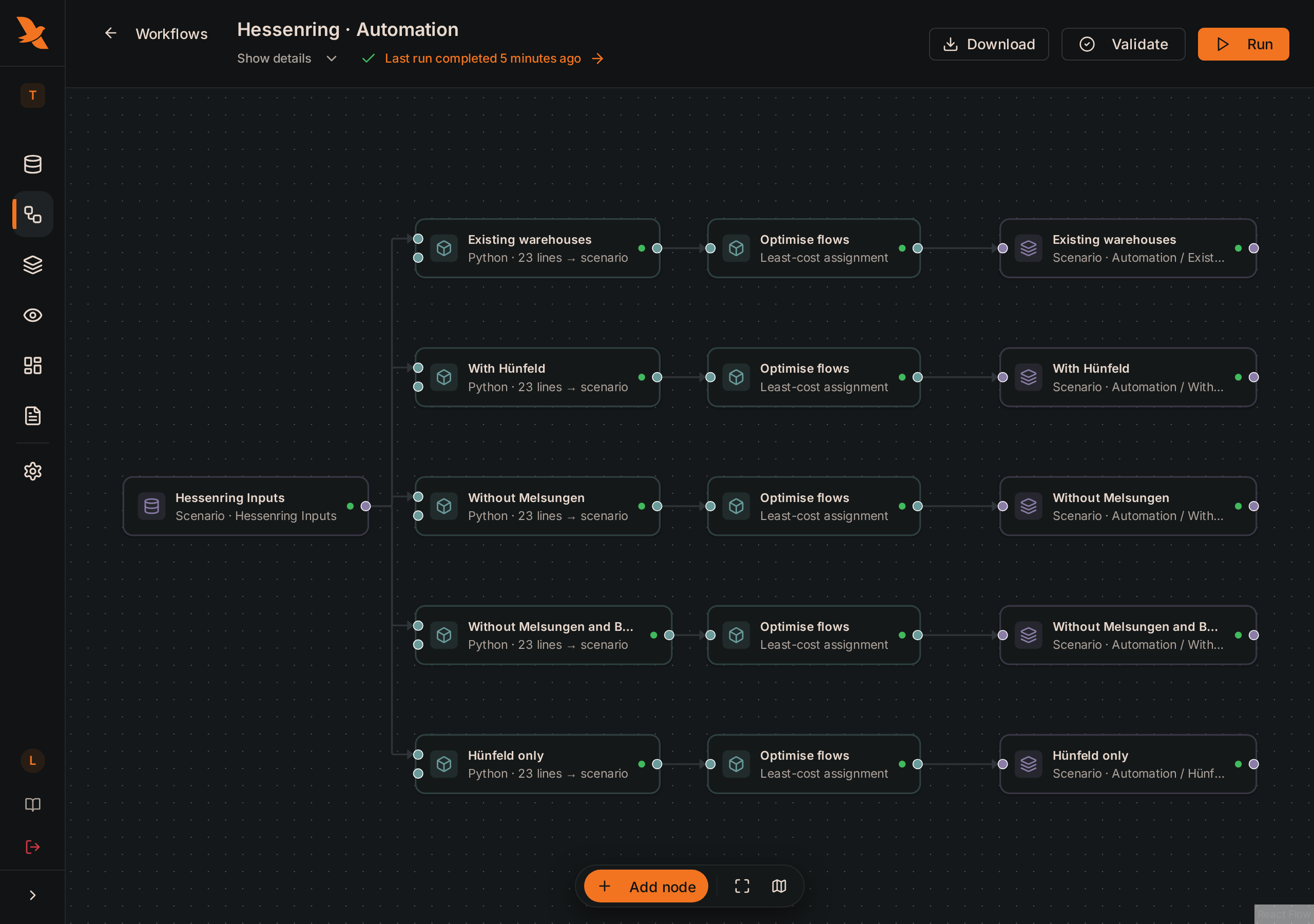
The model has no site costs, so these figures are thresholds. Replacing Melsungen with Hünfeld raises transport and handling costs by €1.37m a year; it pays off if the running costs saved at Melsungen exceed that, after one-off closure and transition costs. Replacing Melsungen and Buseck raises them by €4.94m a year.
For scale: without Melsungen and Buseck, Hünfeld would handle about 1.5 million RC a year, close to our estimate of about 1.65 million for Tegut’s current network. Supplying all 369 stores alone would mean 2.0 million.
From 2029, Edeka Hessenring’s new warehouse in Malsfeld adds a second automated site for dry goods.
04 / Malsfeld
What changes once Malsfeld opens?
From mid-2029, Edeka Hessenring’s new warehouse in Malsfeld handles dry goods with fully automated case picking. We add it for dry goods only, at €9 per roll container. Demand and all other costs stay as before, so this step shows the effect of the new site on its own and does not forecast 2029 volumes or prices.
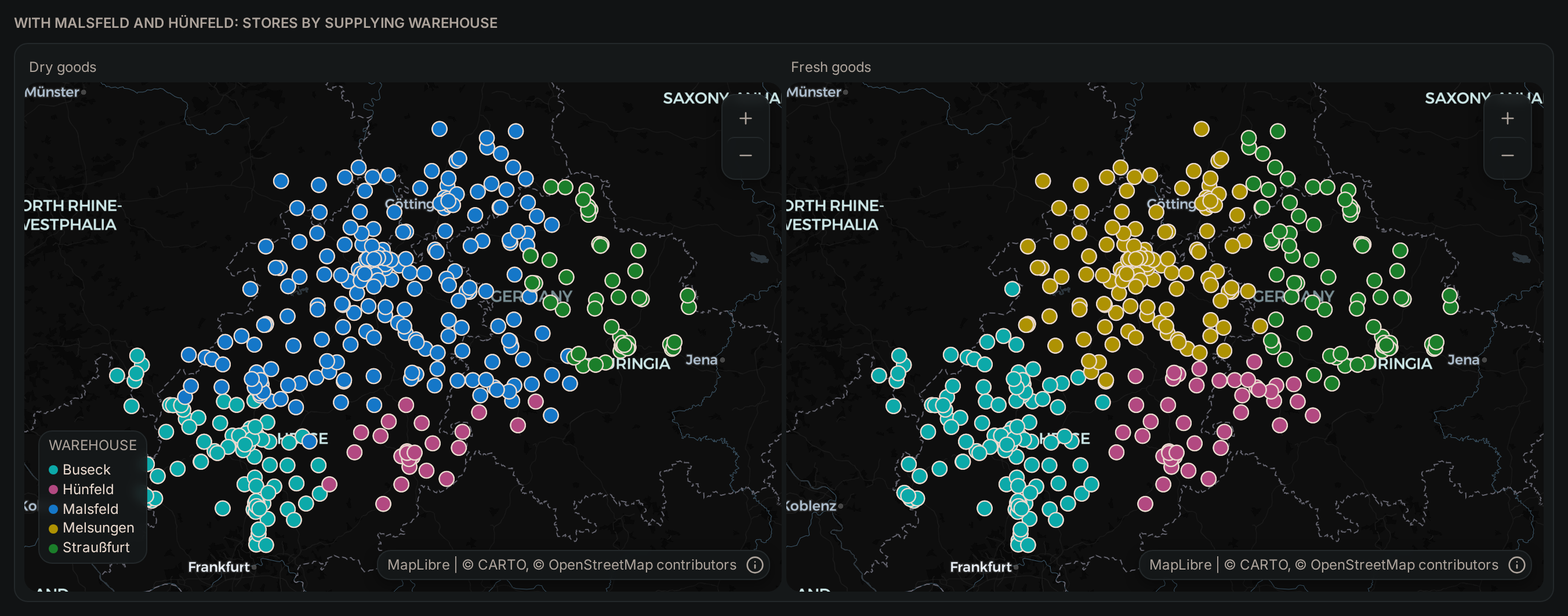
Hessenring plans Malsfeld as the central dry-goods warehouse for a good 500 stores. In our model, it supplies only the stores it can serve most cheaply. Malsfeld lies next to Melsungen: without Hünfeld, it takes over all of Melsungen’s dry goods and supplies 235 stores, and Melsungen only supplies fresh goods from then on.
Annual saving from Hünfeld once Malsfeld runs
€0.58m
Malsfeld takes over many of the dry goods Hünfeld would otherwise handle. Network cost is €35.04m without Hünfeld and €34.46m with it.
Dry goods and fresh goods now go different ways
With Hünfeld available, Malsfeld supplies dry goods to 210 stores. Hünfeld supplies fresh goods to 44 stores and dry goods to 26, all near Fulda. Melsungen supplies fresh goods to 132 stores. Buseck and Straußfurt keep supplying both products in the west and in Thuringia.
Follow one store: Tegut Schrecksbach
Dry goods for Schrecksbach now come from Malsfeld: €3.02 transport plus €9.00 handling makes €12.02. Fresh goods stay with Melsungen at €20.08.
Which warehouses does the network need after 2029?
| Available warehouses (all with Malsfeld) | Change |
|---|---|
| Existing sites + Hünfeld | −€0.58m |
| Hünfeld replaces Melsungen | +€0.99m |
| Hünfeld replaces Melsungen and Buseck | +€3.88m |
| Hünfeld and Malsfeld only | +€6.79m |
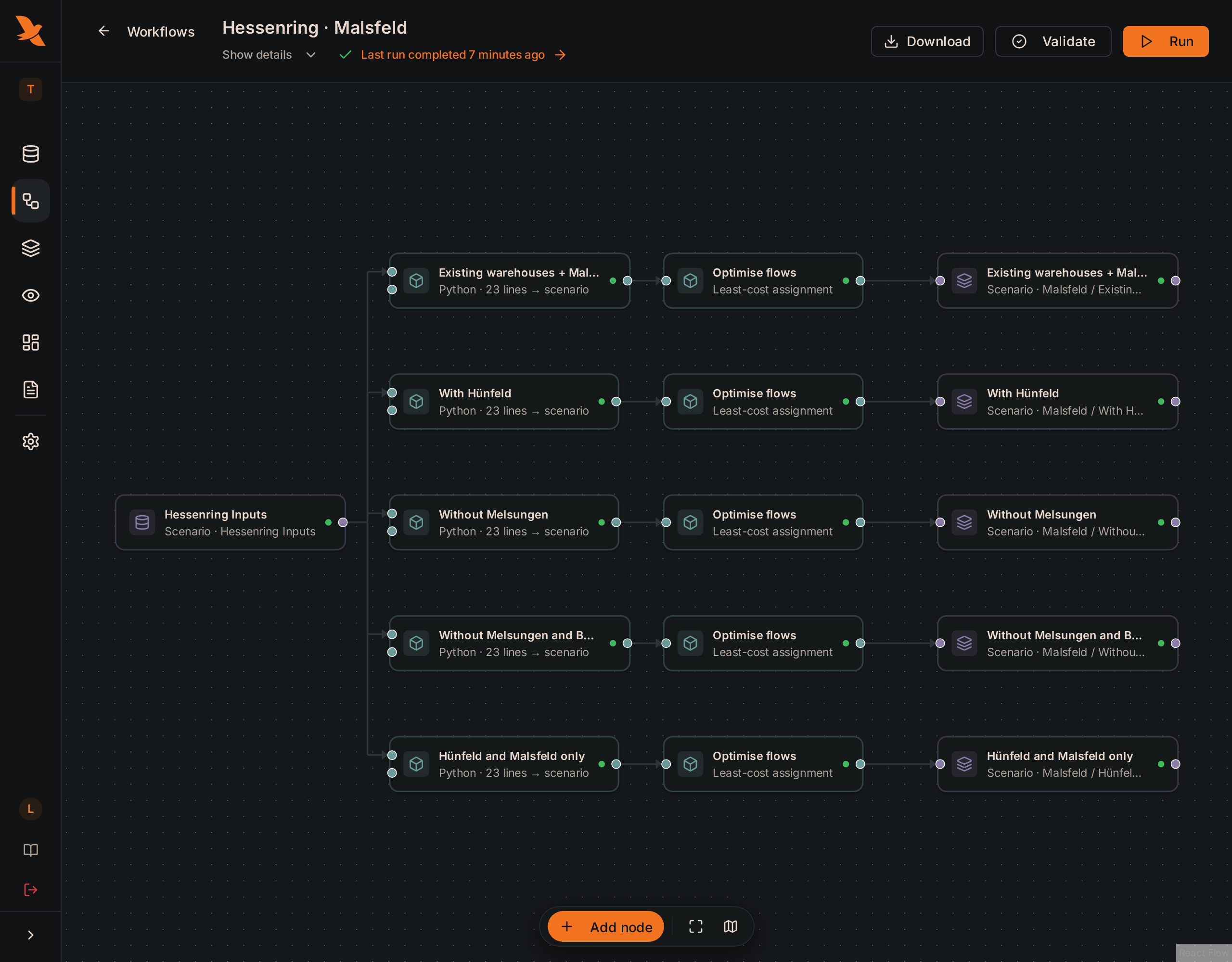
Once Malsfeld handles the dry goods, replacing Melsungen with Hünfeld costs less than before: €0.99m a year compared with €1.37m today. Replacing Melsungen and Buseck costs €3.88m compared with €4.94m. Both thresholds shift towards a smaller network: the lower the additional transport and handling costs, the less a site closure needs to save in running costs to pay off.
For scale: without Melsungen and Buseck, Hünfeld would handle about 0.7 million RC a year, mostly fresh goods. With only Hünfeld and Malsfeld, it would handle 0.9 million, including fresh goods for all 369 stores. Both are below our estimate of about 1.65 million for Tegut’s current network.
These results depend on our assumptions about transport and handling costs and the volume per store. The last section tests them.
05 / Testing the assumptions
How much do the results depend on the assumptions?
Every result so far rests on estimates. We change one assumption at a time and compare the saving from adding Hünfeld to the existing network.
| Test | Today | 2029 |
|---|---|---|
| Main case | €1.15m | €0.58m |
| Same handling cost everywhere (distance only) | €0.91m | – |
| Transport costs 30% lower / higher | €0.90m / €1.42m | €0.34m / €0.83m |
| Smaller automation advantage (Hünfeld €13, Malsfeld €11) | €0.98m | €0.67m |
| Larger automation advantage (Hünfeld €11, Malsfeld €7.50) | €1.36m | €0.54m |
| Higher volume (7,500 RC per store) | €1.57m | €0.79m |
| Dry and fresh goods 50/50 | €1.15m | €0.68m |
Among the cost assumptions, transport has the largest effect. The reason is the break-even distance: Hünfeld’s €1.50 lower dry-goods handling covers about 20 km of extra road distance, and Malsfeld’s €4.50 covers about 59 km. Cheaper transport stretches those limits and dearer transport shrinks them. A larger automation advantage raises Hünfeld’s saving today but lowers it in 2029, because Malsfeld gains more from it.
A higher volume per store raises every figure in the same proportion and leaves the assignments unchanged. A 50/50 split of dry and fresh goods changes little.
Handling rates in each test
| €/RC | Hünfeld | Malsfeld | Manual sites |
|---|---|---|---|
| Main case | 12.00 | 9.00 | 13.50 |
| Same handling cost everywhere | 13.50 | – | 13.50 |
| Smaller automation advantage | 13.00 | 11.00 | 13.50 |
| Larger automation advantage | 11.00 | 7.50 | 13.50 |
Dry goods. Fresh goods cost €14.50 at every site in every test. The transport, volume and split tests use the main-case rates. All rates are tested assumptions; the sites do not publish handling costs.
06 / Conclusion
Learnings and limitations
In this model, Hünfeld lowers Hessenring’s transport and handling costs by about €1.2m a year today, most of it through its location, and by about €0.6m once Malsfeld runs. That gives a ballpark for what Hünfeld adds to the network. It cannot inform a decision on its own.
The model has no site capacities and no site running costs. We tested running costs of €5m, €10m and €15m a year per site. Without capacity limits, the model then keeps only Melsungen, plus Malsfeld from 2029. A footprint decision needs both, together with Edeka’s own volumes and costs. The SCMotif workflows can then run again with those inputs.